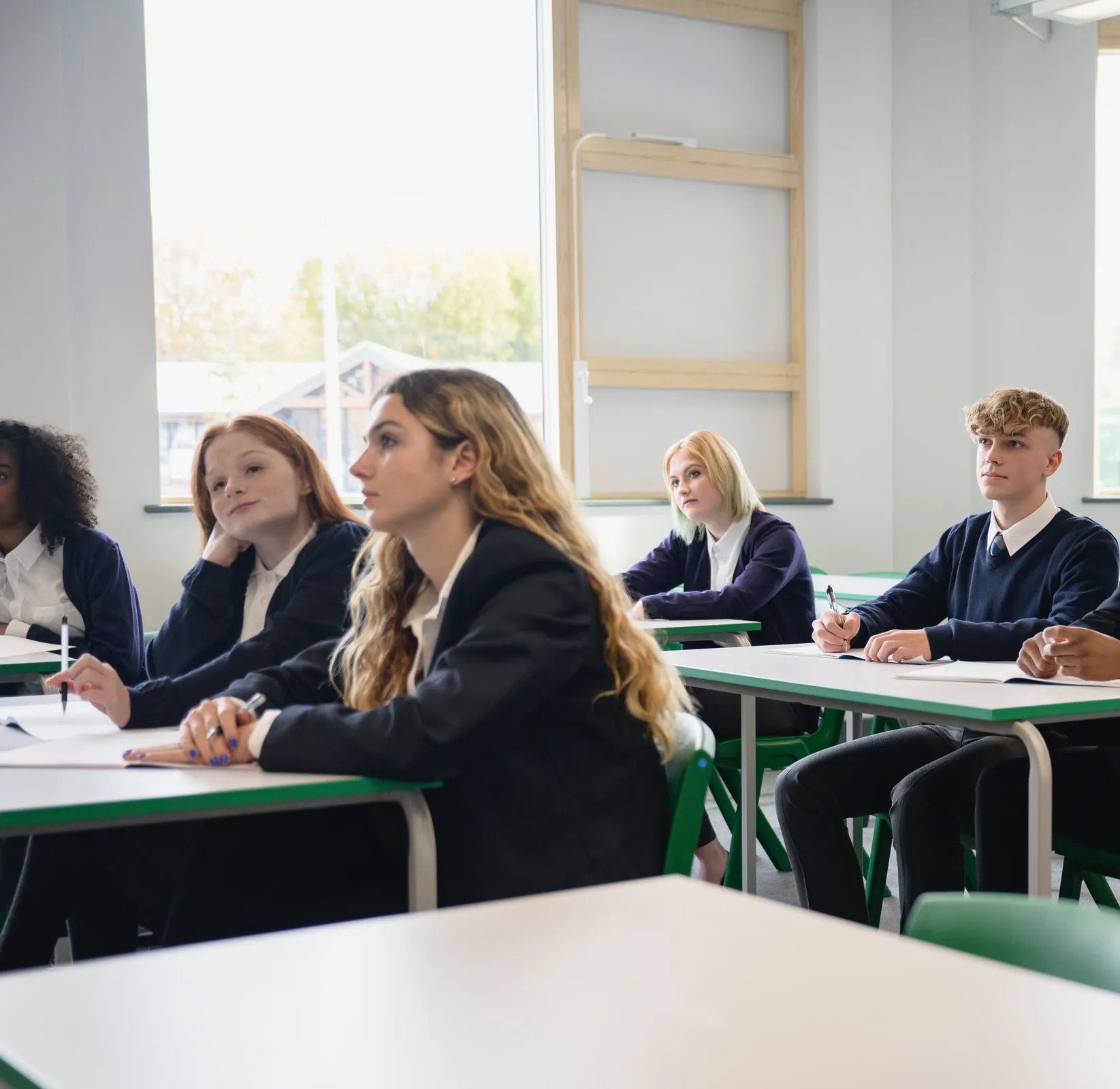

A senior Vaughan College class in session, students in uniform at their desks

Course Catalogue

The full Ontario curriculum, Grades 9 through 12.

We teach the complete Ontario Secondary School Diploma curriculum across Grades 9 to 12, with university, college, mixed, and open courses in every subject area.

The Full Curriculum

Every credit we offer.

From the foundational Grade 9 credits through the senior university-preparation courses that anchor a graduate’s transcript, the catalogue below covers the full breadth of the Ontario curriculum we teach. Filter by grade, subject, or course type to narrow the list to the credits that matter for the path you are planning.

Course catalogue

Every course is offered in person; some are also available online.

Showing 85 of 85 courses

  • A student painting at an easel in an art studio
    AVI3M

    Visual Arts

    Grade 111 Credit

    This course enables students to further develop their knowledge and skills in visual arts. Students will use the creative process to explore a wide range of themes through studio work that may include drawing, painting, sculpting, and printmaking, as well as the creation of collage , multimedia works, and works using emerging technologies. Students will use the critical analysis process when evaluating their own work and the work of others. The course may be delivered as a comprehensive program or through a program focused on a particular art form (e.g., photography, video, computer graphics, information design).

    $580

  • A student painting at an easel in an art studio
    AVI4M

    Visual Arts

    Grade 121 Credit

    This course focuses on enabling students to refine their use of the creative process when creating and presenting two- and three-dimensional art works using a variety of traditional and emerging media and technologies. Students will use the critical analysis process to deconstruct art works and explore connections between art and society. The studio program enables students to explore a range of materials, processes, and techniques that can be applied in their own art production. Students will also make connections between various works of art in personal, contemporary, historical, and cultural contexts.

    $580

  • Students collaborating on a project around laptops
    BAF3M

    Financial Accounting Fundamentals

    Grade 111 Credit

    This course introduces students to the fundamental principles and procedures of accounting. Students will develop financial analysis and decision-making skills that will assist them in future studies and/or career opportunities in business. Students will acquire an understanding of accounting for a service and a merchandising business, computerized accounting, financial analysis, and ethics and current issues in accounting.

    $580

  • Students collaborating on a project around laptops
    BAT4M

    Financial Accounting Principles

    Grade 121 Credit

    This course introduces students to advanced accounting principles that will prepare them for postsecondary studies in business. Students will learn about financial statements for various forms of business ownership and how those statements are interpreted in making business decisions.This course expands students’ knowledge of sources of financing, further develops accounting methods for assets, and introduces accounting for partnerships and corporations.

    $580

  • Students collaborating on a project around laptops
    BBB4M

    International Business Fundamentals

    Grade 121 Credit

    This course provides an overview of the importance of international business and trade in the global economy and explores the factors that influence success in international markets. Students will learn about the techniques and strategies associated with marketing, distribution, and managing international business effectively. This course prepares students for postsecondary programs in business, including international business, marketing, and management.

    $580

  • Students collaborating on a project around laptops
    BEM1O

    Building the Entrepreneurial Mindset

    Grade 91 Credit

    In this course, students will learn what makes an entrepreneur thrive and the skills required to succeed in today’s business environment. Students will begin to develop their own entrepreneurial mindset, and learn why it’s important to take initiative, adapt to change, find creative solutions, and understand the financial considerations of entrepreneurship. This hands-on course will use business software and applications to help students plan and develop their entrepreneurial ideas and learn how to present them to a target audience. Throughout the course, students will enhance their communications skills as well as develop and refine their project management skills, including goal setting, time management, and networking.

    $580

  • Students collaborating on a project around laptops
    BEP2O

    Launching and Leading a Business

    Grade 101 Credit

    This course introduces students to the world of business and what is required to be successful, ethical, and responsible in today’s economy. Students will develop the knowledge and skills needed to be an entrepreneur who knows how to respond to local and global market opportunities. Throughout the course, students will explore and understand the responsibility of managing different functions of a business. This includes accounting, marketing, information and communication technology, financial management, human resources, and production.

    $580

  • Students collaborating on a project around laptops
    BOH4M

    Business Leadership: Management Fundamentals

    Grade 121 Credit

    This course focuses on the development of leadership skills used in managing a successful business. Students will analyse the role of a leader in business, with a focus on decision making, management of group dynamics, workplace stress and conflict, motivation of employees, and planning. Effective business communication skills, ethics, and social responsibility are also emphasized.

    $580

  • An antique world map with a compass and brass instruments
    CGC1W

    Exploring Canadian Geography

    Grade 91 Credit

    This course builds on learning in Grades 7 and 8 in geography. Students will explore relationships within and between Canada’s natural and human systems and how they interconnect with other parts of the world. Students will also examine environmental and economic issues, and their impact related to topics such as natural resources and industries, careers, land use and responsible development, and sustainability. In addition, students will understand the connections that diverse communities and individuals have with the physical environment and each other throughout Canada, including First Nations, Métis, and Inuit perspectives. Students will apply geographic thinking, use the geographic inquiry process, and use geospatial technologies throughout their investigations.

    $580

  • A student reading in a wood-panelled library
    CGR4M

    The Environment and Resource Management

    Grade 121 Credit

    This course investigates interactions between natural and human systems, with a particular emphasis on the impacts of human activity on ecosystems and natural processes. Students will use the geographic inquiry process, apply the concepts of geographic thinking, and employ a variety of spatial skills and technologies to analyse these impacts and propose ways of reducing them. In the course of their investigations, they will assess resource management and sustainability practices, as well as related government policies and international accords. They will also consider questions of individual responsibility and environmental stewardship as they explore ways of developing a more sustainable relationship with the environment.

    $580

  • A student reading in a wood-panelled library
    CGW4U

    World Issues: A Geographic Analysis

    Grade 121 Credit

    In this course, students will address the challenge of creating a more sustainable and equitable world. They will explore issues involving a wide range of topics, including economic disparities, threats to the environment, globalization, human rights, and quality of life, and will analyse government policies, international agreements, and individual responsibilities relating to them. Students will apply the concepts of geographic thinking and the geographic inquiry process, including the use of spatial technologies, to investigate these complex issues and their impacts on natural and human communities around the world.

    $580

  • An antique world map with a compass and brass instruments
    CHC2D

    Canadian History since World War I (effective beginning in the 2026–27 school year)

    Grade 101 Credit

    This course explores social, economic, and political developments and events and their impact on the lives of different individuals, groups, and communities, including First Nations, Métis, and Inuit individuals and communities, in Canada since 1914. Students will examine the role of conflict and cooperation in Canadian society, Canada’s evolving role within the global community, and the impact of various individuals, organizations, and events on identities, citizenship, and heritage in Canada. Students will develop an understanding of some of the political developments and government policies that have had a lasting impact on First Nations, Métis, and Inuit individuals and communities. They will develop their ability to apply the concepts of historical thinking and the historical inquiry process, including the interpretation and analysis of evidence, when investigating key issues and events in Canadian history since 1914.

    $580

  • A student reading in a wood-panelled library
    CHI4U

    Canada: History, Identity, and Culture

    Grade 121 Credit

    This course traces the history of Canada, with a focus on the evolution of our national identity and culture as well as the identity and culture of various groups that make up Canada. Students will explore various developments and events, both national and international, from precontact to the present, and will examine various communities in Canada and how they have contributed to identity and heritage in Canada. Students will investigate the development of culture and identity, including national identity, in Canada and how and why they have changed throughout the country’s history. They will extend their ability to apply the concepts of historical thinking and the historical inquiry process, including the interpretation and analysis of evidence, as they investigate the people, events, and forces that have shaped Canada.

    $580

  • A student reading in a wood-panelled library
    CHV2O

    Civics and Citizenship

    Grade 100.5 Credits

    This course explores rights and responsibilities associated with being an active citizen in a democratic society. Students will explore issues of civic importance and the influence of social media, while developing their understanding of the role of civic engagement and of political processes in the local, national, and/or global community. Students will apply the concepts of political thinking and the political inquiry process to investigate, and express informed opinions about, a range of political issues and developments that are both of significance in today’s world and of personal interest to them. This course also includes learning on digital literacy and critical-thinking skills, the mechanisms of government, Indigenous governance systems and structures, the historical foundations of the rights and freedoms we enjoy in Canada, ways in which government policy affects individuals’ lives and the economy, and ways for students to serve their communities.

    $580

  • An antique world map with a compass and brass instruments
    CHY4U

    World History since the Fifteenth Century

    Grade 121 Credit

    This course traces major developments and events in world history since approximately 1450. Students will explore social, economic, and political changes, the historical roots of contemporary issues, and the role of conflict and cooperation in global interrelationships. They will extend their ability to apply the concepts of historical thinking and the historical inquiry process, including the interpretation and analysis of evidence, as they investigate key issues and ideas and assess societal progress or decline in world history.

    $580

  • A student reading in a wood-panelled library
    CIA4U

    Analysing Current Economic Issues

    Grade 121 Credit

    This course examines current Canadian and international economic issues, developments, policies, and practices from diverse perspectives. Students will explore the decisions that individuals and institutions, including governments, make in response to economic issues such as globalization, trade agreements, economic inequalities, regulation, and public spending. Students will apply the concepts of economic thinking and the economic inquiry process, as well as economic models and theories, to investigate, and develop informed opinions about, economic trade-offs, growth, and sustainability and related economic issues.

    $580

  • A student reading in a wood-panelled library
    CIE3M

    The Individual and the Economy

    Grade 111 Credit

    This course explores issues and challenges facing the Canadian economy as well as the implications of various responses to them. Students will explore the economic role of firms, workers, and government as well as their own role as individual consumers and contributors, and how all of these roles contribute to stability and change in the Canadian economy. Students will apply the concepts of economic thinking and the economic inquiry process, including economic models, to investigate the impact of economic issues and decisions at the individual, regional, and national level.

    $580

  • A student reading in a wood-panelled library
    CLN4U

    Canadian and International Law

    Grade 121 Credit

    This course explores a range of contemporary legal issues and how they are addressed in both Canadian and international law. Students will develop an understanding of the principles of Canadian and international law and of issues related to human rights and freedoms, conflict resolution, and criminal, environmental, and workplace law, both in Canada and internationally. Students will apply the concepts of legal thinking and the legal studies inquiry process, and will develop legal reasoning skills, when investigating these and other issues in both Canadian and international contexts.

    $580

  • A student reading in a wood-panelled library
    CPW4U

    Canadian and International Politics

    Grade 121 Credit

    This course explores various perspectives on issues in Canadian and world politics. Students will explore political decision making and ways in which individuals, stakeholder groups, and various institutions, including governments, multinational corporations, and non-governmental organizations, respond to and work to address domestic and international issues. Students will apply the concepts of political thinking and the political inquiry process to investigate issues, events, and developments of national and international political importance, and to develop and communicate informed opinions about them.

    $580

  • A student writing in a notebook by a sunlit classroom window
    EMS3O

    Media Studies

    Grade 111 Credit

    This course emphasizes knowledge and skills that will enable students to understand media communication in the twenty-first century and to use media effectively and responsibly. Through analysing the forms and messages of a variety of media works and audience responses to them, and through creating their own media works, students will develop critical thinking skills, aesthetic and ethical judgement, and skills in viewing, representing, listening, speaking, reading, and writing.

    $580

  • A student writing in a notebook by a sunlit classroom window
    ENG2D

    English

    Grade 101 Credit

    This course is designed to extend the range of oral communication, reading, writing, and media literacy skills that students need for success in their secondary school academic programs and in their daily lives. Students will analyse literary texts from contemporary and historical periods, interpret and evaluate informational and graphic texts, and create oral, written, and media texts in a variety of forms. An important focus will be on the selective use of strategies that contribute to effective communication. This course is intended to prepare students for the compulsory Grade 11 university or college preparation course.

    $580

  • A student writing in a notebook by a sunlit classroom window
    ENG3C

    English (College)

    Grade 111 Credit

    This course emphasizes the development of literacy, communication, and critical and creative thinking skills necessary for success in academic and daily life. Students will study the content, form, and style of a variety of informational and graphic texts, as well as literary texts from Canada and other countries, and create oral, written, and media texts in a variety of forms for practical and academic purposes. An important focus will be on using language with precision and clarity. The course is intended to prepare students for the compulsory Grade 12 college preparation course.

    $580

  • A student writing in a notebook by a sunlit classroom window
    ENG3U

    English (University)

    Grade 111 Credit

    This course emphasizes the development of literacy, communication, and critical and creative thinking skills necessary for success in academic and daily life. Students will analyse challenging literary texts from various periods, countries, and cultures, as well as a range of informational and graphic texts, and create oral, written, and media texts in a variety of forms. An important focus will be on using language with precision and clarity and incorporating stylistic devices appropriately and effectively. The course is intended to prepare students for the compulsory Grade 12 university or college preparation course.

    $580

  • A student writing in a notebook by a sunlit classroom window
    ENG4C

    English (College)

    Grade 121 Credit

    This course emphasizes the consolidation of literacy, communication, and critical and creative thinking skills necessary for success in academic and daily life. Students will analyse a variety of informational and graphic texts, as well as literary texts from various countries and cultures, and create oral, written, and media texts in a variety of forms for practical and academic purposes. An important focus will be on using language with precision and clarity and developing greater control in writing. The course is intended to prepare students for college or the workplace.

    $580

  • A student writing in a notebook by a sunlit classroom window
    ENG4U

    English (University)

    Grade 121 Credit

    This course emphasizes the consolidation of the literacy, communication, and critical and creative thinking skills necessary for success in academic and daily life. Students will analyse a range of challenging literary texts from various periods, countries, and cultures; interpret and evaluate informational and graphic texts; and create oral, written, and media texts in a variety of forms. An important focus will be on using academic language coherently and confidently, selecting the reading strategies best suited to particular texts and particular purposes for reading, and developing greater control in writing. The course is intended to prepare students for university, college, or the workplace.

    $580

  • A student writing in a notebook by a sunlit classroom window
    ENL1W

    English

    Grade 91 Credit

    This course enables students to continue to develop and consolidate the foundational knowledge and skills that they need for reading, writing, and oral and visual communication. Throughout the course, students will continue to enhance their media literacy and critical literacy skills, and to develop and apply transferable skills, including digital literacy. Students will also make connections to their lived experiences and to society and increase their understanding of the importance of language and literacy across the curriculum.

    $580

  • A student writing in a notebook by a sunlit classroom window
    ESLAO

    English as a Second Language

    ESL Level 11 Credit

    This course builds on students’ previous education and language knowledge to introduce them to the English language and help them adjust to the diversit y in their new environment. Students will use beginning English language skills in listening, speaking, reading, and writing for everyday and essential academic purposes. They will engage in short conversations using basic English language structures and simple sentence patterns ; read short adapted texts ; and write phrases and short sentences. The course also provides students with the knowledge and skills they need to begin to adapt to their new lives in Canada.

    $580

  • A student writing in a notebook by a sunlit classroom window
    ESLBO

    English as a Second Language

    ESL Level 21 Credit

    This course extends students’ listening, speaking, reading, and writing skills in English for everyday and academic purposes. Students will participate in conversations in structured situations on a variety of familiar and new topics; read a variety of texts designed or adapted for English language learners; expand their knowledge of English grammatical structures and sentence patterns; and link English sentences to compose paragraphs. The course also supports students’ continuing adaptation to the Ontario school system by expanding their knowledge of diversity in their new province and country.

    $580

  • A student writing in a notebook by a sunlit classroom window
    ESLCO

    English as a Second Language

    ESL Level 31 Credit

    This course further extends students’ skills in listening, speaking, reading, and writing in English for a variety of everyday and academic purposes. Students will make short classroom oral presentations; read a variety of adapted and original texts in English; and write using a variety of text forms . As well, students will expand their academic vocabulary and their study skills to facilitate their transition to the mainstream school program. This course also introduces students to the rights and responsibilities inherent in Canadian citizenship , and to a variety of current Canadian issues.

    $580

  • A student writing in a notebook by a sunlit classroom window
    ESLDO

    English as a Second Language

    ESL Level 41 Credit

    This course prepares students to use English with increasing fluency and accuracy in classroom and social situations and to participate in Canadian society as informed citizens. Students will develop the oral-presentation, reading, and writing skills required for success in all school subjects. They will extend listening and speaking skills through participation in discussions and seminars; study and interpret a variety of grade-level texts; write narratives, articles, and summaries in English; and respond critically to a variety of print and media texts.

    $580

  • A student writing in a notebook by a sunlit classroom window
    ESLEO

    English as a Second Language

    ESL Level 51 Credit

    This course provides students with the skills and strategies they need to make the transition to college and university preparation courses in English and other secondary school disciplines. Students will be encouraged to develop independence in a range of academic tasks. They will participate in debates and lead classroom workshops; read and interpret literary works and academic texts; write essays, narratives, and reports; and apply a range of learning strategies and research skills effectively. Students will further develop their ability to respond critically to print and media texts.

    $580

  • A student writing in a notebook by a sunlit classroom window
    ETS4U

    Studies in Literature

    Grade 121 Credit

    This course is for students with a special interest in literature and literary criticism. The course may focus on themes, genres , time periods, or countries. Students will analyse a range of forms and stylistic elements of literary texts and respond personally, critically, and creatively to them. They will also assess critical interpretations, write analytical essays, and complete an independent study project.

    $580

  • A student writing in a notebook by a sunlit classroom window
    EWC4U

    The Writer’s Craft

    Grade 121 Credit

    This course emphasizes knowledge and skills related to the craft of writing. Students will analyse models of effective writing; use a workshop approach to produce a range of works; identify and use techniques required for specialized forms of writing ; and identify effective ways to improve the quality of their writing. They will also complete a major paper as part of a creative or analytical independent study project and investigate opportunities for publication and for writing careers.

    $580

  • A teacher mentoring a student one-on-one
    GLC2O

    Career Studies

    Grade 100.5 Credits

    This course gives students the opportunity to develop the skills , knowledge, and habits that will support them in their education and career/life planning. Students will learn about global work trends, and seek opportunities within the school and community to expand and strengthen their transferable skills and their ability to adapt to the changing world of work. On the basis of exploration, reflective practice, and decision-making processes, students will make connections between their skills, interests, and values and their postsecondary options, whether in apprenticeship training, college, community living, university, or the workplace. They will set goals and create a plan for their first postsecondary year. As part of their preparation for the future, they will learn about personal financial management – including the variety of saving and borrowing tools available to them and how to use them to their advantage – and develop a budget for their first year after secondary school.

    $580

  • A teacher mentoring a student one-on-one
    GLE2O

    Learning Strategies 1: Skills for Success in Secondary School

    Grade 101 Credit

    This course focuses on learning strategies to help students become better, more independent learners. Students will learn how to develop and apply literacy and numeracy skills, personal management skills, and interpersonal and teamwork skills to improve their learning and achievement in school, the workplace, and the community. The course helps students build confidence and motivation to pursue opportunities for success in secondary school and beyond.

    $580

  • A teacher mentoring a student one-on-one
    GLS1O

    Learning Strategies 1: Skills for Success in Secondary School

    Grade 91 Credit

    This course focuses on learning strategies to help students become better, more independent learners. Students will learn how to develop and apply literacy and numeracy skills, personal management skills, and interpersonal and teamwork skills to improve their learning and achievement in school, the workplace, and the community. The course helps students build confidence and motivation to pursue opportunities for success in secondary school and beyond.

    $580

  • A teacher mentoring a student one-on-one
    GPP3O

    Leadership and Peer Support

    Grade 111 Credit

    This course prepares students to act in leadership and peer support roles. They will design and implement a plan for contributing to their school and/or community; develop skills in communication, interpersonal relations, teamwork, and conflict management; and apply those skills in leadership and/or peer support roles – for example, as a student council member or a peer tutor. Students will examine group dynamics and learn the value of diversity within groups and communities.

    $580

  • A teacher mentoring a student one-on-one
    GWL3O

    Designing Your Future

    Grade 111 Credit

    This course prepares students to make successful transitions to postsecondary destinations as they investigate specific postsecondary options based on their skills, interests, and personal characteristics. Students will explore the realities and opportunities of the workplace and examine factors that affect success, while refining their job-search and employability skills. Students will develop their portfolios with a focus on their targeted destination and develop an action plan for future success.

    $580

  • Students talking together in a seminar discussion
    HFA4U

    Nutrition and Health

    Grade 121 Credit

    This course examines the relationships between food, energy balance, and nutritional status; the nutritional needs of individuals at different stages of life; and the role of nutrition in health and disease. Students will evaluate nutrition-related trends and will determine how food choices can promote food security and environmental responsibility. Students will learn about healthy eating, expand their repertoire of food-preparation techniques, and develop their social science research skills by investigating issues related to nutrition and health.

    $580

  • Students talking together in a seminar discussion
    HFC3M

    Food and Culture

    Grade 111 Credit

    This course focuses on the flavours, aromas, cooking techniques, foods, and cultural traditions of world cuisines. Students will explore the origins of and developments in diverse food traditions. They will demonstrate the ability to cook with ingredients and equipment from a variety of cultures, compare food-related etiquette in many countries and cultures, and explain how Canadian food choices and traditions have been influenced by other cultures. Students will develop practical skills and apply social science research methods while investigating foods and food practices from around the world.

    $580

  • Students talking together in a seminar discussion
    HHS4U

    Families in Canada

    Grade 121 Credit

    This course enables students to draw on sociological, psychological, and anthropological theories and research to analyse the development of individuals, intimate relationships, and family and parent-child relationships. Students will focus on issues and challenges facing individuals and families in Canada’s diverse society. They will develop analytical tools that enable them to assess various factors affecting families and to consider policies and practices intended to support families in Canada. They will develop the investigative skills required to conduct and communicate the results of research on individuals, intimate relationships, and parent-child relationships.

    $580

  • Students talking together in a seminar discussion
    HSB4U

    Challenge and Change in Society

    Grade 121 Credit

    This course focuses on the use of social science theories, perspectives, and methodologies to investigate and explain shifts in knowledge, attitudes, beliefs, and behaviour and their impact on society. Students will critically analyse how and why cultural, social, and behavioural patterns change over time. They will explore the ideas of social theorists and use those ideas to analyse causes of and responses to challenges such as technological change, deviance, and global inequalities. Students will explore ways in which social science research methods can be used to study social change.

    $580

  • Students talking together in a seminar discussion
    HSP3U

    Introduction to Anthropology, Psychology, and Sociology

    Grade 111 Credit

    This course provides students with opportunities to think critically about theories, questions, and issues related to anthropology, psychology, and sociology. Students will develop an understanding of the approaches and research methods used by social scientists. They will be given opportunities to explore theories from a variety of perspectives, to conduct social science research, and to become familiar with current thinking on a range of issues within the three disciplines.

    $580

  • Students talking together in a seminar discussion
    HZT4U

    Philosophy: Questions and Theories

    Grade 121 Credit

    This course enables students to acquire an understanding of the nature of philosophy and philosophical reasoning skills and to develop and apply their knowledge and skills while exploring specialized branches of philosophy (the course will cover at least three of the following branches: metaphysics, ethics, epistemology, philosophy of science, social and political philosophy, aesthetics). Students will develop critical thinking and philosophical reasoning skills as they formulate and evaluate arguments related to a variety of philosophical questions and theories. They will also develop research and inquiry skills related to the study and practice of philosophy.

    $580

  • A student writing code on a laptop
    ICD2O

    Digital Technology and Innovations in the Changing World

    Grade 101 Credit

    This course helps students develop cutting-edge digital technology and computer programming skills that will support them in contributing to and leading the global economic, scientific and societal innovations of tomorrow. Students will learn and apply coding concepts and skills to build hands-on projects and investigate artificial intelligence, cybersecurity, and other emerging digital technologies that connect to a wide range of fields and careers. Using critical thinking skills with a focus on digital citizenship, students will investigate the appropriate use and development of the digital technologies that they encounter every day, as well as the benefits and limitations of these technologies.

    $580

  • Students collaborating on a project around laptops
    IDC3O

    Interdisciplinary Studies

    Grade 111 Credit

    This course will help students combine the skills required for and knowledge of different subjects and disciplines to solve problems, make decisions, create personal meaning, and present findings beyond the scope of a single subject or discipline. Through individual and collaborative inquiry and research, students will analyse the connections among diverse subjects and disciplines; develop information literacy skills in analysing, selecting, evaluating, and communicating information; and become aware of a variety of resources and viewpoints on contemporary issues. They will also examine their own learning styles, relate their inquiries and research to real-life situations, and investigate career opportunities in new disciplines.

    $580

  • Students collaborating on a project around laptops
    IDC4O

    Interdisciplinary Studies (Open)

    Grade 121 Credit

    This course emphasizes the development of practical skills and knowledge to solve problems, make decisions, create personal meaning, and present findings beyond the scope of a single subject or discipline. Through individual and collaborative inquiry and research into contemporary issues, real-life situations, and careers, students will apply the principles and skills derived from the complementary subjects and disciplines studied, evaluate the reliability of information, and examine how information technology can be used safely, effectively, and legally. They will also learn how to select strategies to define problems, research alternative solutions, assess their thinking in reaching decisions, and adapt to change as they acquire new knowledge.

    $580

  • Students collaborating on a project around laptops
    IDC4U

    Interdisciplinary Studies (University)

    Grade 121 Credit

    This course will help students develop and consolidate the skills required for and knowledge of different subjects and disciplines to solve problems, make decisions, create personal meaning, and present findings beyond the scope of a single subject or discipline. Students will apply the principles and processes of inquiry and research to effectively use a range of print, electronic, and mass media resources; to analyse historical innovations and exemplary research; and to investigate real-life situations and career opportunities in interdisciplinary endeavours. They will also assess their own cognitive and affective strategies, apply general skills in both familiar and new contexts, create innovative products, and communicate new knowledge.

    $580

  • An antique world map with a compass and brass instruments
    LVV4U

    Classical Civilization

    Grade 121 Credit

    This course introduces students to the rich cultural legacy of the classical world. Students will investigate aspects of classical culture, including mythology, literature, art, architecture, philosophy, science, and technology, as well as elements of the ancient Greek and Latin languages. Students will develop creative and critical thinking skills through exploring and responding to works by classical authors in English translation and examining material culture brought to light through archaeology. They will also increase their communication and research skills by working both collaboratively and independently, and will acquire an understanding and appreciation of the interconnectedness of ancient and modern societies.

    $580

  • A hand working through algebra on a chalkboard
    MBF3C

    Foundations for College Mathematics

    Grade 111 Credit

    This course enables students to broaden their understanding of mathematics as a problemsolving tool in the real world. Students will extend their understanding of quadratic relations; investigate situations involving exponential growth; solve problems involving compound interest; solve financial problems connected with vehicle ownership; develop their ability to reason by collecting, analysing, and evaluating data involving one variable; connect probability and statistics; and solve problems in geometry and trigonometry. Students will consolidate their mathematical skills as they solve problems and communicate their thinking.

    $580

  • A hand working through algebra on a chalkboard
    MCR3U

    Functions

    Grade 111 Credit

    This course introduces the mathematical concept of the function by extending students’ experiences with linear and quadratic relations. Students will investigate properties of discrete and continuous functions, including trigonometric and exponential functions; represent functions numerically, algebraically, and graphically; solve problems involving applications of functions; investigate inverse functions; and develop facility in determining equivalent algebraic expressions. Students will reason mathematically and communicate their thinking as they solve multi-step problems.

    $580

  • A hand working through algebra on a chalkboard
    MCV4U

    Calculus and Vectors

    Grade 121 Credit

    This course builds on students’ previous experience with functions and their developing understanding of rates of change. Students will solve problems involving geometric and algebraic representations of vectors and representations of lines and planes in threedimensional space; broaden their understanding of rates of change to include the derivatives of polynomial, sinusoidal, exponential, rational, and radical functions; and apply these concepts and skills to the modelling of real-world relationships. Students will also refine their use of the mathematical processes necessary for success in senior mathematics. This course is intended for students who choose to pursue careers in fields such as science, engineering, economics, and some areas of business, including those students who will be required to take a university-level calculus, linear algebra, or physics course. Note: The new Advanced Functions course (MHF4U) must be taken prior to or concurrently with Calculus and Vectors (MCV4U).

    $580

  • A hand working through algebra on a chalkboard
    MDM4U

    Mathematics of Data Management

    Grade 121 Credit

    This course broadens students’ understanding of mathematics as it relates to managing data. Students will apply methods for organizing and analysing large amounts of information; solve problems involving probability and statistics; and carry out a culminating investigation that integrates statistical concepts and skills. Students will also refine their use of the mathematical processes necessary for success in senior mathematics. Students planning to enter university programs in business, the social sciences, and the humanities will find this course of particular interest.

    $580

  • A hand working through algebra on a chalkboard
    MHF4U

    Advanced Functions

    Grade 121 Credit

    This course extends students’ experience with functions. Students will investigate the properties of polynomial, rational, logarithmic, and trigonometric functions; develop techniques for combining functions; broaden their understanding of rates of change; and develop facility in applying these concepts and skills. Students will also refine their use of the mathematical processes necessary for success in senior mathematics. This course is intended both for students taking the Calculus and Vectors course as a prerequisite for a university program and for those wishing to consolidate their understanding of mathematics before proceeding to any one of a variety of university programs.

    $580

  • A hand working through algebra on a chalkboard
    MPM2D

    Principles of Mathematics

    Grade 101 Credit

    This course enables students to broaden their understanding of relationships and extend their problem-solving and algebraic skills through investigation, the effective use of technology, and abstract reasoning. Students will explore quadratic relations and their applications; solve and apply linear systems; verify properties of geometric figures using analytic geometry; and investigate the trigonometry of right and acute triangles. Students will reason mathematically and communicate their thinking as they solve multi-step problems.

    $580

  • A hand working through algebra on a chalkboard
    MTH1W

    Mathematics

    Grade 91 Credit

    This course enables students to consolidate, and continue to develop, an understanding of mathematical concepts related to number sense and operations, algebra, measurement, geometry, data, probability, and financial literacy. Students will use mathematical processes, mathematical modelling, and coding to make sense of the mathematics they are learning and to apply their understanding to culturally responsive and relevant real-world situations. Students will continue to enhance their mathematical reasoning skills, including proportional reasoning, spatial reasoning, and algebraic reasoning, as they solve problems and communicate their thinking.

    $580

  • Students talking together in a seminar discussion
    NAC1O

    Expressions of First Nations, Métis, and Inuit Cultures

    Grade 91 Credit

    This course explores various arts disciplines (dance, drama, installation and performance art, media arts, music, storytelling, utilitarian or functional art, visual arts), giving students the opportunity to create, present, and analyse art works, including integrated art works/ productions, that explore or reflect First Nations , Métis , and Inuit perspectives and cultures. Students will examine the interconnected relationships between art forms and individual and cultural identities, histories, values, protocols, and ways of knowing and being. They will demonstrate innovation as they learn and apply art-related concepts, methods, and conventions, and acquire skills that are transferable beyond the classroom. Students will use the creative process and responsible practices to explore solutions to creative arts challenges.

    $580

  • Students talking together in a seminar discussion
    NAC2O

    First Nations, Métis, and Inuit in Canada

    Grade 101 Credit

    This course explores the histories of First Nations and Inuit in Canada from precontact, as well as Métis from their beginnings, to the present day. Students will examine the continuing impact of past social, cultural, economic, political, and legal trends and developments on First Nations, Métis and Inuit individuals and communities. Students will apply the concepts of historical thinking and the historical inquiry process to investigate a range of issues, events, and interactions that have affected First Nations, Métis, and Inuit individuals and communities, including those that continue to affect relations between Indigenous and non-Indigenous peoples in Canada.

    $580

  • Students talking together in a seminar discussion
    NBE3C

    English: Understanding Contemporary First Nations, Métis, and Inuit Voices (College)

    Grade 111 Credit

    This course explores the themes, forms, and stylistic elements of literary, informational, graphic, oral, cultural, and media text forms emerging from First Nations , Métis , and Inuit cultures in Canada, and also looks at the perspectives and influences of texts that relate to those cultures. In order to understand contemporary text forms and their themes of identity, relationship, and self-determination, sovereignty , or self-governance, students will study the use of text forms by Indigenous authors/creators from other periods in expressing ideas related to these themes. Students will also create oral, written, and media texts to explore their own ideas and understanding, focusing on the development of literacy, communication, and critical and creative thinking skills necessary for success in academic and daily life. The course is intended to prepare students for the compulsory Grade 12 English college preparation course.

    $580

  • Students talking together in a seminar discussion
    NBE3E

    English: Understanding Contemporary First Nations, Métis, and Inuit Voices (Workplace)

    Grade 111 Credit

    This course explores themes, forms, and stylistic elements of literary, informational, graphic, oral, cultural, and media texts emerging from First Nations , Métis , and Inuit cultures in Canada, as well as some texts that relate to those cultures. In order to better understand contemporary texts, students will explore connections between traditional and contemporary text forms and cultural and community aspects of identity, relationships, and self-determination, sovereignty , or self-governance. Students will also create oral, written, and media texts focusing on the development of literacy, communication, and critical thinking skills necessary for success in the workplace and daily life. The course is intended to prepare students for the compulsory Grade 12 English workplace preparation course.

    $580

  • Students talking together in a seminar discussion
    NBE3U

    English: Understanding Contemporary First Nations, Métis, and Inuit Voices

    Grade 111 Credit

    This course explores the themes, forms, and stylistic elements of a variety of literary, informational, graphic, oral, cultural, and media text forms emerging from First Nations , Métis , and Inuit cultures in Canada, and also examines the perspectives and influence of texts that relate to those cultures. In order to fully understand contemporary text forms and their themes of identity, relationship, and self-determination, sovereignty , or self-governance, students will analyse the changing use of text forms by Indigenous authors/creators from various periods and cultures in expressing ideas related to these themes. Students will also create oral, written, and media texts to explore their own ideas and understanding, focusing on the development of literacy, communication, and critical and creative thinking skills necessary for success in academic and daily life. The course is intended to prepare students for the compulsory Grade 12 English university or college preparation course.

    $580

  • Students talking together in a seminar discussion
    NBV3C

    World Views and Aspirations of First Nations, Métis, and Inuit Communities in Canada (College)

    Grade 111 Credit

    This course explores the diverse knowledge, world views, and aspirations that shape the actions of First Nations , Métis , and Inuit individuals and communities in Canada. Students will examine the historical and contemporary context of those beliefs, values, aspirations, and actions, including the impact of colonization and decolonization . Students will explore the factors that shape world views to develop an understanding of how acknowledging diverse cultures, values, and ways of knowing contributes to truth, reconciliation, and renewed nation-to-nation relationships . Students are also given the opportunity to develop their own problem-solving strategies to build mutual understanding related to First Nations, Métis, and Inuit world views and aspirations.

    $580

  • Students talking together in a seminar discussion
    NBV3E

    World Views and Aspirations of First Nations, Métis, and Inuit Communities in Canada (Workplace)

    Grade 111 Credit

    This course explores diverse knowledge, world views, and aspirations that shape the actions of First Nations , Métis , and Inuit individuals and communities in Canada. Students will examine issues of identity facing First Nations, Métis, and Inuit individuals and communities with respect to changing relationships with the land, nature, one another, and Canada. Students will explore their own and others’ world views, and the factors that shape world views over time, to develop an understanding of how traditional and contemporary beliefs and values influence the aspirations and practices of First Nations, Métis, and Inuit communities. Students are given the opportunity to develop further understanding about the impacts of colonization and how reconciling diverse knowledge, world views, and aspirations contributes to a call for societal understanding.

    $580

  • Students talking together in a seminar discussion
    NDA3M

    Contemporary First Nations, Métis, and Inuit Issues and Perspectives

    Grade 111 Credit

    This course explores existing and emerging issues of local, regional, and national importance to First Nations , Métis , and Inuit in Canada. Students will analyse diverse perspectives on issues and events related to land, community, governance, identity, culture, and global trends. Using the concepts of political thinking and the tools of political inquiry, students will explore their own and others’ ideas and investigate issues to determine what needs to change and why. Students are also given the opportunity to develop their own problem-solving strategies to address an issue of their choice.

    $580

  • Students talking together in a seminar discussion
    NDG4M

    First Nations, Métis, and Inuit Governance in Canada

    Grade 121 Credit

    This course explores aspects of First Nations , Métis , and Inuit governance in Canada as well as laws, policies, and judicial decisions that have affected and continue to affect the lives of Indigenous peoples in this country. Students will investigate historical and contemporary relations between First Nations, Métis, and Inuit communities and colonial, federal, and provincial/territorial governments and will develop their understanding of Indigenous rights in Canada. Students will examine how traditional values and cultural practices inform models of Indigenous governance and leadership as they explore strategies being used to revitalize and strengthen First Nations, Métis, and Inuit sovereignty , self-governance , and self-determination in Canada.

    $580

  • Students talking together in a seminar discussion
    NDW4M

    Contemporary Indigenous Issues and Perspectives in a Global Context

    Grade 121 Credit

    This course examines global issues from the perspectives of Indigenous peoples. Students will explore the depth and diversity of Indigenous cultures, traditions, and knowledge. Students will consider how diverse Indigenous communities persevere despite current global environmental and economic trends, and will investigate topics such as identity, social justice, human rights, spirituality, resilience, and advocacy for change.

    $580

  • A student writing in a notebook by a sunlit classroom window
    OLC4O

    Ontario Secondary School Literacy Course

    Grade 121 Credit

    This course is designed to help students acquire and demonstrate the cross-curricular literacy skills that are evaluated by the Ontario Secondary School Literacy Test (OSSLT). Students who complete the course successfully will meet the provincial literacy requirement for graduation. Students will read a variety of informational, narrative, and graphic texts and will produce a variety of forms of writing, including summaries, information paragraphs, opinion pieces, and news reports. Students will also maintain and manage a portfolio containing a record of their reading experiences and samples of their writing. Eligibility requirement: Students who have been eligible to write the OSSLT at least twice and who have been unsuccessful at least once are eligible to take the course. (Students who have already met the literacy requirement for graduation may be eligible to take the course under special circumstances, at the discretion of the principal.)

    $580

  • A student bumping a volleyball in the gymnasium
    PAD1O

    Healthy Active Living Education

    Grade 91 Credit

    This course equips students with the knowledge and skills they need to make healthy choices now and lead healthy, active lives in the future. Through participation in a wide range of physical activities, students develop knowledge and skills related to movement competence and personal fitness that provide a foundation for active living. Students also acquire an understanding of the factors and skills that contribute to healthy development and learn how their own well-being is affected by, and affects, the world around them. Students build their sense of self, learn to interact positively with others, and develop their ability to think critically and creatively.

    $580

  • A student bumping a volleyball in the gymnasium
    PAD2O

    Healthy Active Living Education

    Grade 101 Credit

    This course enables students to further develop the knowledge and skills they need to make healthy choices now and lead healthy, active lives in the future. Through participation in a wide range of physical activities, students develop knowledge and skills related to movement competence and personal fitness that provide a foundation for active living. Students also acquire an understanding of the factors and skills that contribute to healthy development and learn how their own well-being is affected by, and affects, the world around them. Students build their sense of self, learn to interact positively with others, and develop their ability to think critically and creatively.

    $580

  • A student bumping a volleyball in the gymnasium
    PAD3O

    Healthy Active Living Education

    Grade 111 Credit

    This course enables students to further develop the knowledge and skills they need to make healthy choices now and lead healthy, active lives in the future. Through participation in a wide range of physical activities and exposure to a broader range of activity settings, students enhance their movement competence, personal fitness, and confidence. Students also acquire an understanding of the factors and skills that contribute to healthy development and learn how their own well-being is affected by, and affects, the world around them. Students build their sense of self, learn to interact positively with others, and develop their ability to think critically and creatively.

    $580

  • A student bumping a volleyball in the gymnasium
    PAD4O

    Healthy Active Living Education

    Grade 121 Credit

    This course enables students to further develop the knowledge and skills they need to make healthy choices. It places special emphasis on how students can maintain the habits of healthy, active living throughout their lives as they make the transition to adulthood and independent living. Through participation in a wide range of physical activities in a variety of settings, students can enhance their movement competence, personal fitness, and confidence. Students also acquire an understanding of the factors and skills that contribute to healthy development and learn how their own well-being is affected by, and affects, the world around them. Students build their sense of self, learn to interact positively with others, and develop their ability to think critically and creatively.

    $580

  • A student bumping a volleyball in the gymnasium
    PLF4M

    Recreation and Healthy Active Living Leadership

    Grade 121 Credit

    This course enables students to explore the benefits of lifelong participation in active recreation and healthy leisure and to develop the leadership and coordinating skills needed to plan, organize, and safely implement recreational events and other activities related to healthy, active living. Students will also learn how to promote the benefits of healthy, active living to others through mentoring and assisting them in making informed decisions that enhance their well-being. The course will prepare students for university programs in physical education and health and kinesiology and for college and university programs in recreation and leisure management, fitness and health promotion, and fitness leadership.

    $580

  • A student bumping a volleyball in the gymnasium
    PSK4U

    Introductory Kinesiology

    Grade 121 Credit

    This course focuses on the study of human movement and of systems, factors, and principles involved in human development. Students will learn about the effects of physical activity on health and performance, the evolution of physical activity and sport, and the physiological, psychological, and social factors that influence an individual’s participation in physical activity and sport. The course prepares students for university programs in physical education and health, kinesiology, health sciences, health studies, recreation, and sports administration.

    $580

  • A student looking through a microscope in a biology lab
    SBI3U

    Biology

    Grade 111 Credit

    This course furthers students’ understanding of the processes that occur in biological systems. Students will study theory and conduct investigations in the areas of biodiversity; evolution; genetic processes; the structure and function of animals; and the anatomy, growth, and function of plants. The course focuses on the theoretical aspects of the topics under study, and helps students refine skills related to scientific investigation

    $580

  • A student looking through a microscope in a biology lab
    SBI4U

    Biology

    Grade 121 Credit

    This course provides students with the opportunity for in-depth study of the concepts and processes that occur in biological systems. Students will study theory and conduct investigations in the areas of biochemistry, metabolic processes, molecular genetics, homeostasis, and population dynamics. Emphasis will be placed on the achievement of detailed knowledge and the refinement of skills needed for further study in various branches of the life sciences and related fields.

    $580

  • A student using a pipette and flask in a chemistry lab
    SCH3U

    Chemistry

    Grade 111 Credit

    This course enables students to deepen their understanding of chemistry through the study of the properties of chemicals and chemical bonds; chemical reactions and quantitative relationships in those reactions; solutions and solubility; and atmospheric chemistry and the behaviour of gases. Students will further develop their analytical skills and investigate the qualitative and quantitative properties of matter, as well as the impact of some common chemical reactions on society and the environment

    $580

  • A student using a pipette and flask in a chemistry lab
    SCH4U

    Chemistry

    Grade 121 Credit

    This course enables students to deepen their understanding of chemistry through the study of organic chemistry, the structure and properties of matter, energy changes and rates of reaction, equilibrium in chemical systems, and electrochemistry. Students will further develop their problem-solving and investigation skills as they investigate chemical processes, and will refine their ability to communicate scientific information. Emphasis will be placed on the importance of chemistry in everyday life and on evaluating the impact of chemical technology on the environment.

    $580

  • A student examining a test tube in a school science class
    SES4U

    Earth and Space Science

    Grade 121 Credit

    This course develops students’ understanding of Earth and its place in the universe. Students will investigate the properties of and forces in the universe and solar system and analyse techniques scientists use to generate knowledge about them. Students will closely examine the materials of Earth, its internal and surficial processes, and its geological history, and will learn how Earth’s systems interact and how they have changed over time. Throughout the course, students will learn how these forces, processes, and materials affect their daily lives. The course draws on biology, chemistry, physics, and mathematics in its consideration of geological and astronomical processes that can be observed directly or inferred from other evidence.

    $580

  • A student examining a test tube in a school science class
    SNC1W

    Science

    Grade 91 Credit

    This course enables students to develop their understanding of concepts related to biology, chemistry, physics, and Earth and space science, and to relate science to technology, society, and the environment. Throughout the course, students will develop and refine their STEM skills as they use scientific research, scientific experimentation, and engineering design processes to investigate concepts and apply their knowledge in situations that are relevant to their lives and communities. Students will continue to develop transferable skills as they become scientifically literate global citizens.

    $580

  • A student examining a test tube in a school science class
    SNC2D

    Science

    Grade 101 Credit

    This course enables students to enhance their understanding of concepts in biology, chemistry, Earth and space science, and physics, and of the interrelationships between science, technology, society, and the environment. Students are also given opportunities to further develop their scientific investigation skills. Students will plan and conduct investigations and develop their understanding of scientific theories related to the connections between cells and systems in animals and plants; chemical reactions, with a particular focus on acid–base reactions; forces that affect climate and climate change; and the interaction of light and matter.

    $580

  • A student building an electronic circuit at a workbench
    SPH3U

    Physics

    Grade 111 Credit

    This course develops students’ understanding of the basic concepts of physics. Students will explore kinematics, with an emphasis on linear motion; different kinds of forces; energy transformations; the properties of mechanical waves and sound; and electricity and magnetism. They will enhance their scientific investigation skills as they test laws of physics. In addition, they will analyse the interrelationships between physics and technology, and consider the impact of technological applications of physics on society and the environment.

    $580

  • A student building an electronic circuit at a workbench
    SPH4U

    Physics

    Grade 121 Credit

    This course enables students to deepen their understanding of physics concepts and theories. Students will continue their exploration of energy transformations and the forces that affect motion, and will investigate electrical, gravitational, and magnetic fields and electromagnetic radiation. Students will also explore the wave nature of light, quantum mechanics, and special relativity. They will further develop their scientific investigation skills, learning, for example, how to analyse, qualitatively and quantitatively, data related to a variety of physics concepts and principles. Students will also consider the impact of technological applications of physics on society and the environment.

    $580

  • A student working at a lathe wearing ear protection
    TAS1O

    Technology and the Skilled Trades

    Grade 91 Credit

    This hands-on course enables students to further explore the engineering design process and develop other technological knowledge and skills introduced in earlier grades. Students will design and safely create prototypes, products, and/or services, working with tools and technologies from various industries. As students develop their projects to address real-life problems, they will apply technological concepts such as precision measurement, as well as health and safety standards. Students will begin to explore job skills programs and education and training pathways, including skilled trades, that can lead to a variety of careers.

    $580

  • A student working at a lathe wearing ear protection
    TAS2O

    Technology and the Skilled Trades

    Grade 101 Credit

    This hands-on course enables students to apply the engineering design process and other technological knowledge and skills introduced in earlier grades. Students will design and safely create prototypes, products, and/or services, working with tools and resources from various industries. As students develop their projects to address real-life problems, they will apply technological concepts such as quality control, and health and safety standards. Students explore opportunities for job skills programs and education and training pathways, including skilled trades, that can lead to a variety of careers.

    $580

  • A student writing code on a laptop
    TGJ3M

    Communications Technology

    Grade 111 Credit

    This course examines communications technology from a media perspective. Students will develop knowledge and skills as they design and produce media projects in the areas of live, recorded, and graphic communications. These areas may include TV, video, and movie production; radio and audio production; print and graphic communications; photography; digital imaging; broadcast journalism; and interactive new media. Students will also develop an awareness of related environmental and societal issues, and will explore college and university programs and career opportunities in the various communications technology fields.

    $580

Still Looking

Don’t see what you need?

Course offerings rotate by semester and our team can advise on prerequisites, pathway sequencing, and credit equivalency from a previous school.